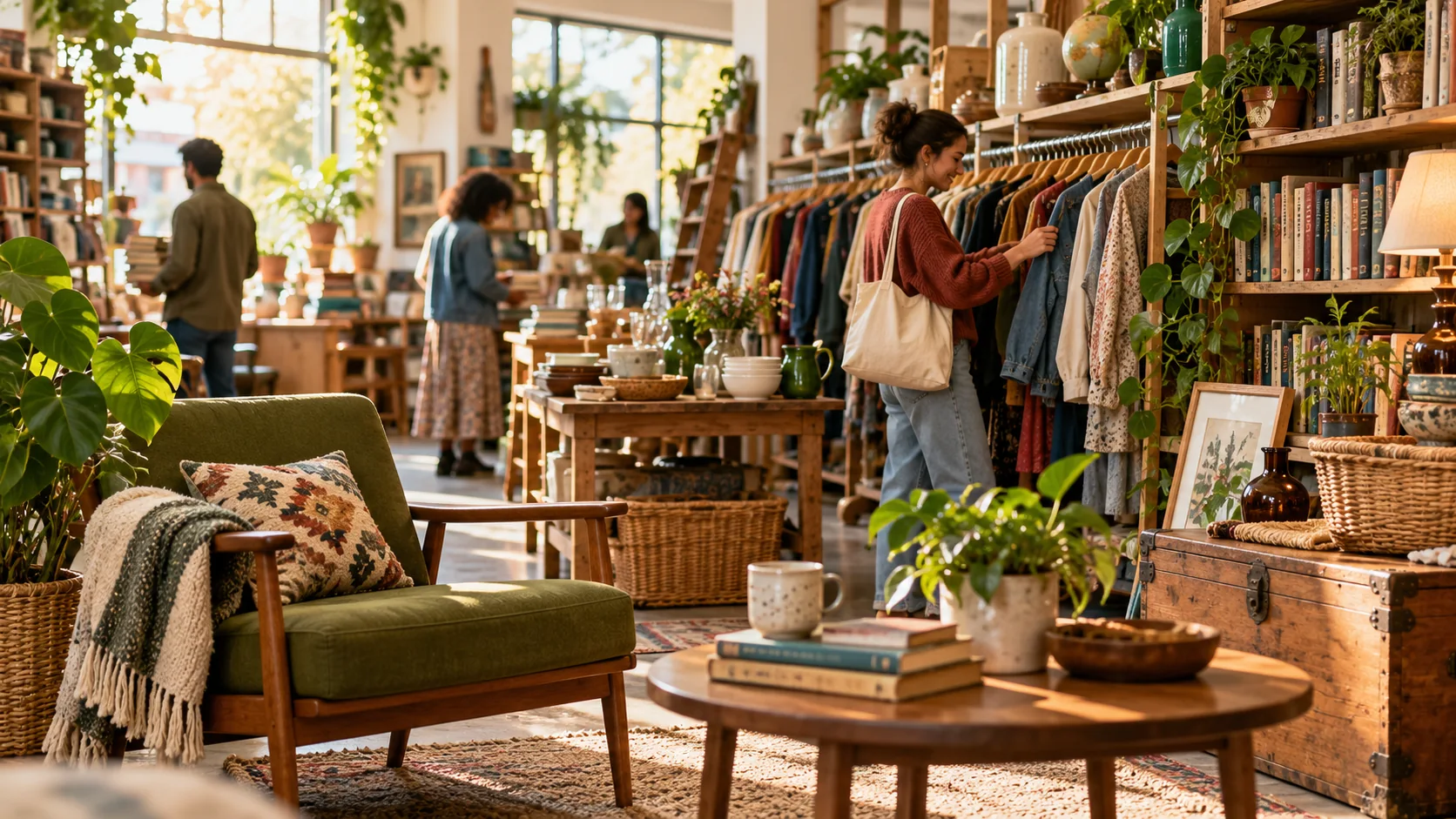
What if we all chose preloved a little more often?
You do not have to rebuild your whole life around sustainability. One charity-shop find, one repaired favourite, one thing passed on instead of binned. Repeated across millions of people, tiny choices stop being tiny.
The one-swap experiment
If 100 people swapped one new clothing purchase for preloved…
Using WRAP’s 2025 UK weighted-average resale displacement rate of 64.6%, that could mean:
65
new clothing purchases potentially displaced
Illustrative scenario. “Displaced” means the preloved purchase replaces a purchase that would otherwise have been new.
Why this matters for the climate
The problem is not just what we throw away. It is how much new stuff we keep producing.
Fashion and textiles are responsible for an estimated 2–8% of global greenhouse-gas emissions. Making new clothing means fibres, farming or fossil-fuel feedstocks, processing, dyeing, factories, packaging and transport. Keeping clothes in use for longer can reduce the pressure to keep feeding that production cycle.
2–8%
of global greenhouse-gas emissions
UNEP’s current estimate for the textile industry.
+17%
more textiles placed on the market
WRAP reported this increase among UK Textiles Pact signatories in 2024 versus 2019.
+10%
overall carbon footprint
Despite carbon impact per tonne falling 6%, higher volumes pushed the total footprint up.
1.12m tCO₂e
reported for 2024
Reuse and recycling are already showing climate value at scale
WRAP reports that UK Textiles Pact reuse and recycling signatories displaced 1.12 million tonnes of CO₂e in 2024. Circularity is not just about tidier bins. It is part of cutting the need for carbon-intensive new production.
This is the fast-fashion problem in one sentence
Making each item slightly better is not enough if we keep making and buying more and more of them.
WRAP’s latest UK data shows exactly that tension: efficiency improvements were outweighed by rising volumes. Reuse, repair and resale matter because they can help meet needs without automatically triggering another brand-new purchase.
1
Choose preloved
Use an item that already exists.
2
Displace a new sale
WRAP finds around 3 in 5 preloved clothing purchases replace a new purchase.
3
Reduce production pressure
Lower demand for new sales weakens the signal for ever-higher production volumes.
4
Cut climate impact
Less new production can mean less carbon, water use, processing and transport.
Move the sliders and see how small changes build over a year, across a group, or across the country. These are illustrative calculations using the research figures shown on this page.
Your year
Buy a little more preloved
How many preloved clothing items might you buy in a typical month?
Preloved items per month2
24
preloved items across a year
16
new purchases potentially displaced
The second figure applies WRAP’s 64.6% average resale displacement rate. It is an estimate, not a claim that every second-hand purchase prevents a new one.
A specific swap
Make the jeans preloved
If these second-hand jeans genuinely replace pairs you would otherwise buy new:
Second-hand pairs per year1
30kg+
potential CO₂e saving
Based on WRAP’s example that a second-hand pair of jeans bought online instead of a new pair could save more than 30kg CO₂e. Real savings vary by product and behaviour.
Repair instead of replace
Keep the T-shirt going
How many cotton T-shirts might you repair rather than replacing with brand-new ones?
T-shirts repaired per year2
15kg+
potential CO₂e saving
WRAP estimates that repairing one cotton T-shirt instead of buying a new one could save more than 7.5kg CO₂e.
Get people involved
What if your group made one swap?
Imagine this many people each buying one preloved clothing item.
People taking part100
65
new purchases potentially displaced
Useful for picturing the effect of a workplace, school, club, town or event getting behind one simple preloved challenge.
Scale it up
What if part of the UK joined in?
Choose a share of the UK population. Give each participating person one preloved clothing purchase.
UK population taking part10%
6,948,700
people making one preloved purchase
4,488,860
new purchases potentially displaced
Uses the ONS provisional mid-2025 UK population estimate and WRAP’s average resale displacement rate. This is a scale illustration, not a prediction.
Your carbon snapshot
45kg+ CO₂e
Based only on the specific jeans and repaired cotton T-shirt examples above. Your generic preloved purchases are deliberately not converted into carbon because different garments have very different footprints.
If you do this…
…then this starts to happen
Four simple ways to turn abstract sustainability into something you can actually picture.
Buy one preloved item every week
That is 52 preloved purchases a year. At WRAP’s average displacement rate, roughly 34 new purchases could be displaced.
Choose one second-hand pair of jeans
If it replaces buying that pair new, WRAP’s example suggests a saving of more than 30kg CO₂e.
Keep clothes in active use for nine months longer
WRAP research suggests their carbon, water and waste footprints can fall by up to 20%.
Keep one textile item out of general waste
Do that once and it is one item. If 1,000 people do it, that is 1,000 textile items given a chance to stay in use through repair, reuse, resale or appropriate donation.
The good stuff
Preloved by the numbers
5 → 3
Preloved really can replace new
WRAP found that for every five preloved clothing items bought, about three new purchases are displaced on average.
The Charity Retail Association says charity shops reuse or recycle more than 90% of donated clothing and books, and 85% of electrical goods. That means your clear-out can become somebody else’s find instead of somebody else’s waste problem.
Buying from charity shops can support charitable causes, local high streets, volunteering and more affordable access to everyday goods. Sustainability is not only about what we avoid. It is also about what we keep circulating in our communities.
A good purchase can have more than one life and more than one beneficiary.
The journey counts too
Make the thrifty trip part of the impact
Walking, cycling or using public transport can reduce the travel footprint of a shopping trip compared with making an equivalent journey by car. The exact impact varies by vehicle, occupancy, route and service, so ThriftyMap does not pretend there is one magic number.
The Journey Planner now includes a public-transport option. It organises your chosen stops and then hands the route to Google Maps for live bus and rail information, alongside walking, cycling and driving choices.
Repair it if a small fix gives it another chapter.
✓
Donate or resell good things you no longer use.
✓
Check charity shops, vintage and reuse stores before buying new.
Preloved is not a licence to buy endlessly. The lowest-impact item is often the one you already have. But when you do need something, second-hand is a very good place to start.
Ready to make one swap?
Find charity shops, vintage stores and other places keeping useful things in circulation near you.